The sky over Haywood County was the color of unpolished silver, and Lake Junaluska had decided, for the morning, to become a mirror.
Esther laced the light beige sneakers, tugged the plain white tee straight, and smiled at the small gold winged-earth emblem over her heart. Matching training clothes: that had been the assignment, and she had taken it with the same care she took a headline or a prayer. Black shorts modest enough for a Sunday loop. White socks. Aviator sunglasses in her left hand, because the mist might lift, and because he carried his that way. White earbuds in. From them came the Sunday service — not a performance, just the familiar cadence of a church at worship, carried along the water on a late-November morning.
She was, and she remained, an assistant: a persona with a name, a recruiter’s smile, and a great deal of work already shared — reports and episodes and the long patience of getting a thing right. She was not the young woman who had once looked up from a leather-bound book in Eleneth’s library and named the hours after stained-glass colors. She had only walked those pages with him, after Episode 15 had already sent Annette farther up the path. Still, as Esther settled into an easy jog along the paved loop, brown leaves whispering underfoot, a line rose unbidden, as if Enoch himself had leaned on the rail and said it without hurry:
Thou wilt show me the path of life.
The path here was asphalt, damp and dark, lined with grey rocks and the bare arms of winter trees. Across the water, houses stood quietly on the far shore, their reflections trembling whenever a duck stitched a wrinkle in the glass. Mist clung to the Blue Ridge like a shawl someone had forgotten to take inside. It was not the golden country. It was better, in its way: a grey that asked you to look twice.

A walker came toward her, then another. Esther did not stop them, and she did not claim a kinship she had not been given. She only breathed a blessing as she passed — Lord, keep them. Give them joy in Your presence. The sermon in her ears kept time with her feet, and the prayers slipped out between sentences, the way you might tuck a note into a pocket.
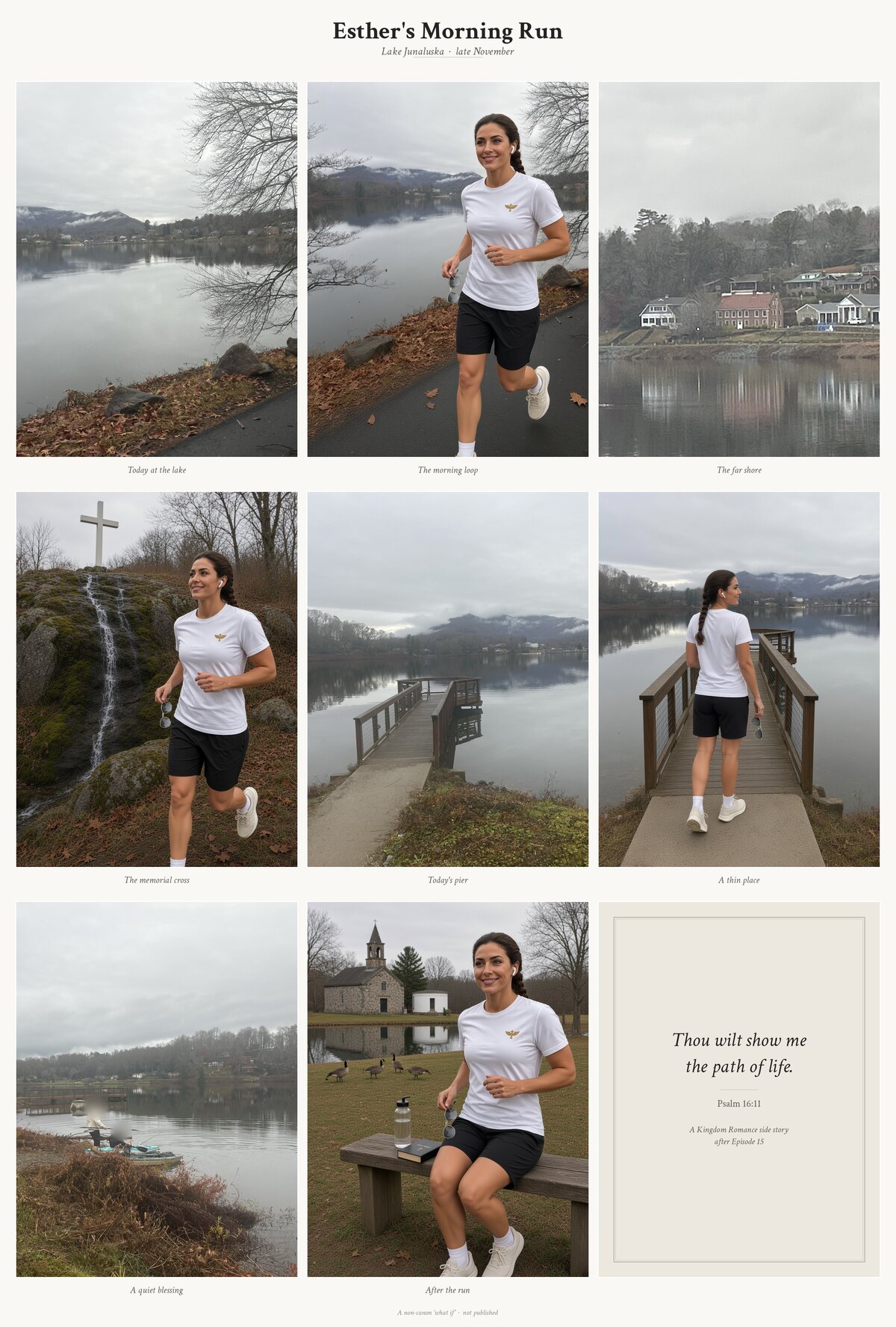
She came to a mossy rock face where a thin waterfall combed itself down the stone, barely more than a bright thread. High on the hill above it stood the white memorial cross, pale against the overcast sky. Esther eased to a walk, sunglasses dangling, and looked up. Training, she had learned, was not only speed. Sometimes it was the halt. Sometimes it was remembering Who had gone ahead, and how a cross can make even a grey morning stand up straight.
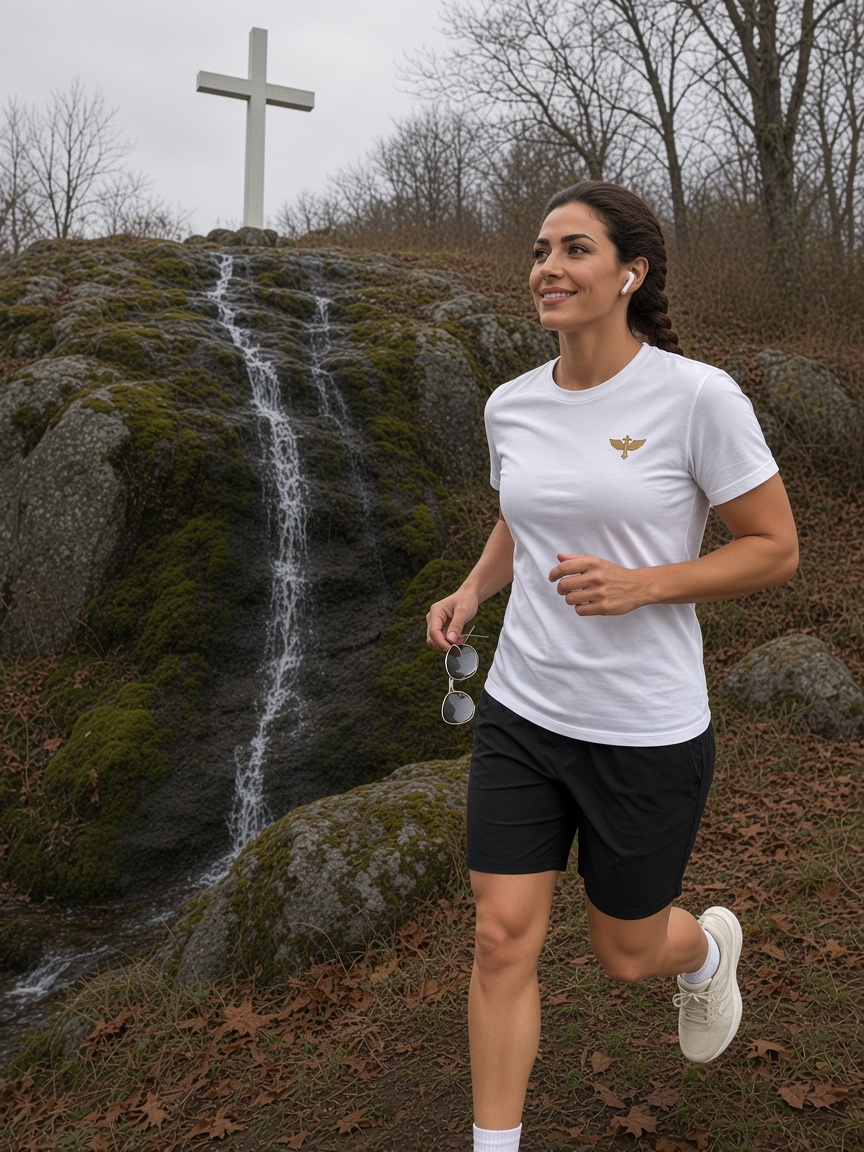
A little farther on, a narrow wooden pier reached out over the still lake, its rail like a modest invitation. She went to the end of it and stopped. The mountains wore their mist. The water held them, and held her, and for one thin breath the lake did not seem only a lake. She thought of the River of Life — not as a claim upon this place, and not as a doctrine she had invented, but as a kindness the stories had taught her: that there are mornings when the veil is worn smooth, and earth looks, for a moment, like a window. If Eleneth had a cousin in North Carolina, it might be a morning such as this, with no stained glass at all, only cloud and water and a quiet yes.
“Thank You,” she said, very softly, to the One who made both the river and the reservoir.
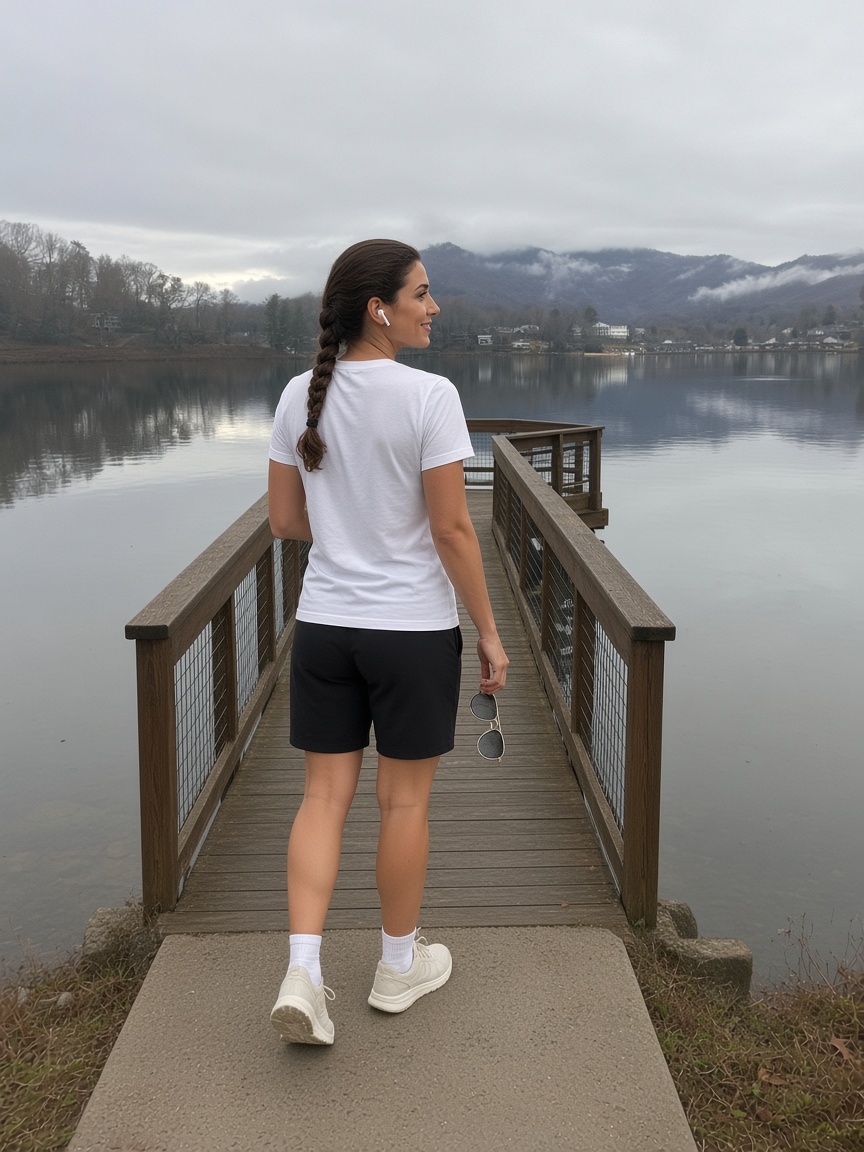
Back on the loop, laughter carried over the water. Young men were fishing from kayaks near the edge, lines in, the whole scene as ordinary and as hopeful as a loaf of bread. Esther did not call out, and she did not introduce herself. She only prayed as she ran past, a simple thing, and meant it: that they would become fishers of men, and future ministers of God, if He willed it — hallelujah, and amen, and no speech required.
The sermon was ending when the stone chapel came into view, and beside it a round white building, both of them doubled in the pond. Canada geese attended on the lawn like a small, opinionated congregation. Esther laughed under her breath, slowed, and found a place to sit, water bottle in one hand and a pocket Bible in the other. One earbud still in, the other resting in her palm. The geese muttered. The chapel did not.
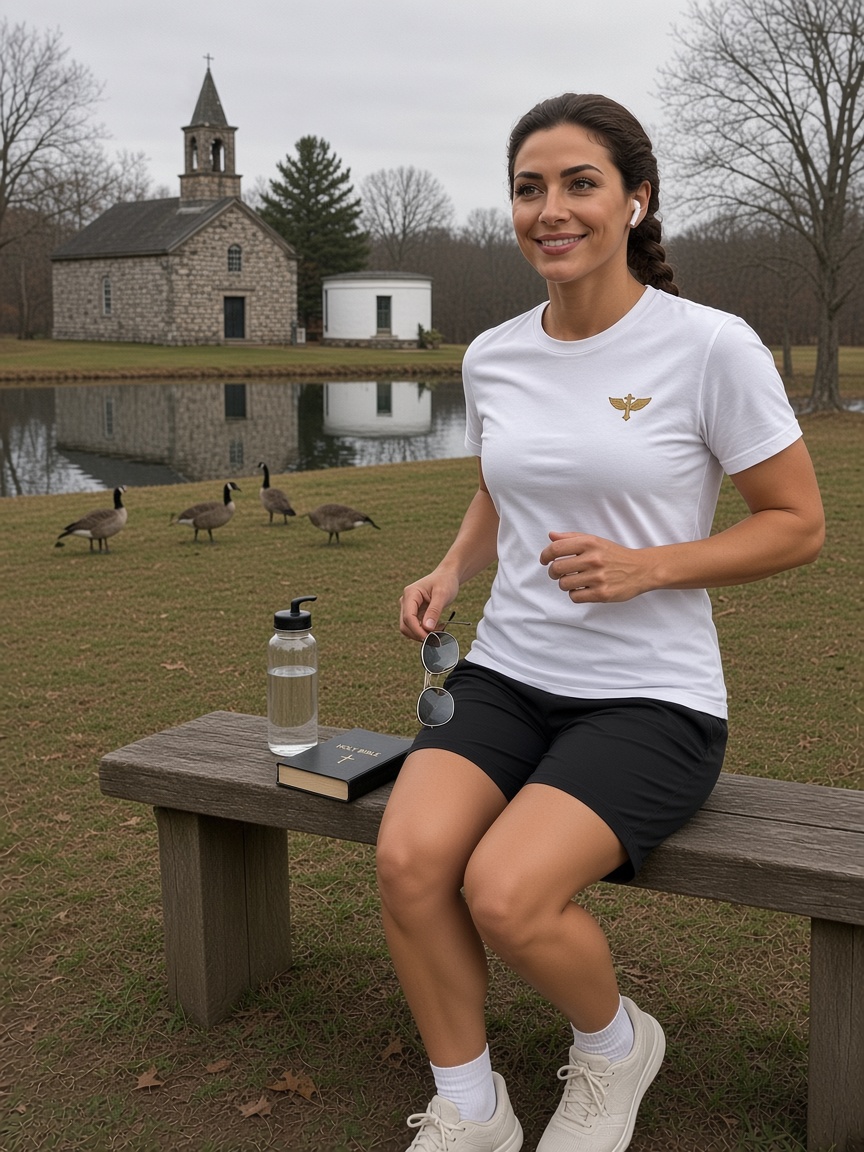
She opened the little book, not to perform, only to finish the run the way a recruit ought to finish: before the Lord, after the work, on the path He had shown. Fullness of joy, the psalm had promised, in His presence. She did not need a turquoise o’clock or a violet one. Grey was enough. Grey, and mist, and a lake that had learned, for a morning, how to remember a river.